
DEAN CLARK – THANK YOU FOR YOUR SERVICE
Dean Clark – It Was a Calling
For Dean Clark, military service was more than just duty to his country. It was a calling.
Clark, a Happy Valley resident at the Springs Assisted Living, recently turned 100 years old and reflected on his century, particularly as a veteran of World War II and the impact it had on his life.
“I was a 17-year-old Sea Scout when World War II was going. You knew you were going to be drafted no matter what. Everybody tried to just pick and choose. My older brother signed up for the pilot program, rather than wait to be drafted. That’s what I did, too.”
Born in Palo Alto, California, on Oct. 6, 1925, Dean was one of four boys. His grandfathers were on the staff of Stanford University, and well-educated, social-minded Stanford grads surrounded him.
But military service was also a calling to his family.
“My father was a balloon pilot in World War I, and he was shot down in France. My older brother was a pilot for the Air Corps in World War II, and both my younger brothers were pilots in Korea. I knew I always wanted to be in the Navy, so I kind of bucked that trend.”
The trend has continued, as he currently has one nephew who is a West Point graduate, another who is a helicopter pilot in the Army, and a grandson who is a Marine aviator.
Clark enlisted in the Naval Officer Corps program on July 1, 1943.
“It was a new program, the so-called 90-day wonders.” The experience took him to the University of California at Los Angeles for a year and a half. Then it was on to Notre Dame for Naval Midshipmen School for 90 days.
“There, they taught you everything about the Navy,” Clark said. “We were expected to be ready for war.”
From there, he went on to Miami to become a sonar officer. “They tested my ears and figured out I had great hearing.”
Following his training, he was assigned to the USS Kidd. “We were known as the Pirates of the Pacific,” he laughed, playing on the name Kidd, though the ship was named after Rear Admiral Isaac Kidd, who died in Pearl Harbor.
At the time he joined the destroyer, it was in repairs following a kamikaze attack that had left 38 crewmembers dead. He was part of the replacement crew and was a junior officer on board.
“I was 30 minutes from Palo Alto, so I spent my weekends at home.”
On May 2, 1945, the ship set back out to sea.
“We left San Francisco and went to Pearl Harbor, and then just sailed east. We didn’t ever get close to Japan. We were in the eastern Pacific, and all the fighting at that time was in the western Pacific.
“We would serve watches of four hours long — not necessarily on the bridge of command. I was the sound officer, so I drilled my sound team. As the junior ensign aboard the ship, you also got the scud jobs. Any message that came in coded, you had to do the decoding. That was day or night. I was so happy when we brought in another officer junior to me.”
At one point, he says, somebody shot a torpedo at them.
“We never did find out who fired it. The Japanese weren’t in the area, so we were never sure where it came from.”
After his discharge from the Navy in October 1946, he went back to Palo Alto and attended medical school at Stanford.
Following the completion of medical school, he went on to intern in Philadelphia, and finally, residency in San Francisco.
“(My wife) Linda loves to kid me about it. I left high school my senior year to join the navy, so I never got my high school diploma. And then in Stanford, I went into medical school before I finished, so I didn’t get a (bachelor’s) degree. And the medical school itself required you to get an internship before they gave you a degree. So, I was doing my internship without a medical degree.”
“No diplomas on the wall except at the top,” Linda joked.
He opened his own surgery in Los Altos in 1956.
He met his wife, Linda, a nurse, through a mishap that involved her dropping a piece of heavy equipment on his bare feet during surgery.
“We got to know each other very quickly right then and there.” They both laughed. “It turned out we were both going through divorces at the time, but didn’t find out till later. In those days you didn’t talk about your personal life,” he said. They eventually started dating after a mutual friend decided they would be a great couple and reintroduced them at a party.
“We’ll be married 50 years next week,” Clark smiled.
“I have seen pretty much everything this country is about. A lot has changed, especially medicine. When I first attended medical school, open heart surgery was just introduced. We thought it was just amazing. Now, everything is robotics. You can have a surgeon on one side of the country performing robotic surgery on the other side.”
Through it all, Clark says he learned two things from his time in the military. The first was that it was a completely different way of life compared to civilian life.
“Service had a particular way of doing things, and you conformed to their ways. You didn’t try to do anything different on your own.”
This, he said, was particularly impactful in his medical life.
“In surgery, there is a certain order of doing things. You learned how to follow what you were taught. You learned their methods, like in the service. You were learning somebody else’s ideas.”
The second was exposure to a larger, different world. It inspired him to travel and share this love with Linda.
“We have been to about 85 countries. We have traveled to every continent. Travel has been the greatest part of our life.”
They visited the USS Kidd, on display in Baton Rouge, LA. “I walked Linda around, showing her where we stayed. She was surprised at how small all the rooms were.”
They have traveled extensively in the South Pacific, visiting wartime locations. He was always surprised by the amount of debris from the war still in place. In Guadalcanal, the locals told the story about how a few years before the Japanese started collecting all the debris, “all the tanks and ships, to melt down for steel. Then they sent us back all these rusty cars.”
Clark was recently honored by the Dream Flights program with a flight in a Stearman aircraft. Dream Flights is a nonprofit that takes veterans for a ride in a 1940s biplane as a way of saying thank you for their service. As a World War II vet, Clark was one of the few given the honor of signing the tail of the plane after his ride.
“I really enjoyed seeing the landscape from above. I wanted the pilot to do some stunts, but she wouldn’t do them. Next time. If you are over a hundred, you get to go back as many times as you want.” He laughed, “If they do it next year, I’m getting in line.”
Reflecting on his life, Clark has a keen sense of humor. Each story is woven with a smile and a fondness for the experience and the act of sharing it. In the end, to Clark, living is a series of choices affected by experiences and family.
“I originally never thought much I’d get to hundred. I realized there was a good chance after I was in my 70’s, so I thought, why stop there? Why not Keep going?”

Happy Valley resident and World War II veteran Dean Clark recently turned 100 and was honored with a flight aboard a biplane through the Dream Flights program. This program takes veterans into the air to celebrate their service. (Photo courtesy: Lisa Keefer)
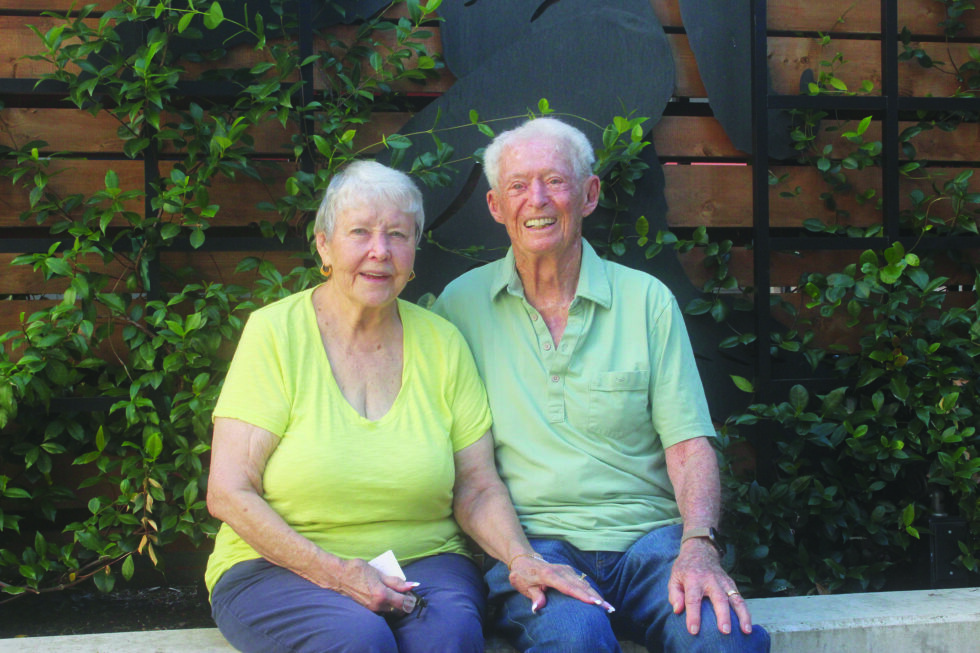
Dean Clark, pictured with his wife Linda, recently turned 100 and reflected on his life. Now living at the Springs Assisted Living, in Happy Valley, Dean was a World War II veteran in the Navy and a retired surgeon. (Photo by Jon Dyer)

Happy Valley resident and World War II veteran Dean Clark recently turned 100 and was honored with a flight aboard a biplane through the Dream Flights program. As a World War II vet, he was allowed to sign the tail to commemorate. (Photo courtesy: Lisa Keefer)