
Comprehensive Plan Update
The Happy Valley Comprehensive Plan is intended to guide the City’s future growth and development.
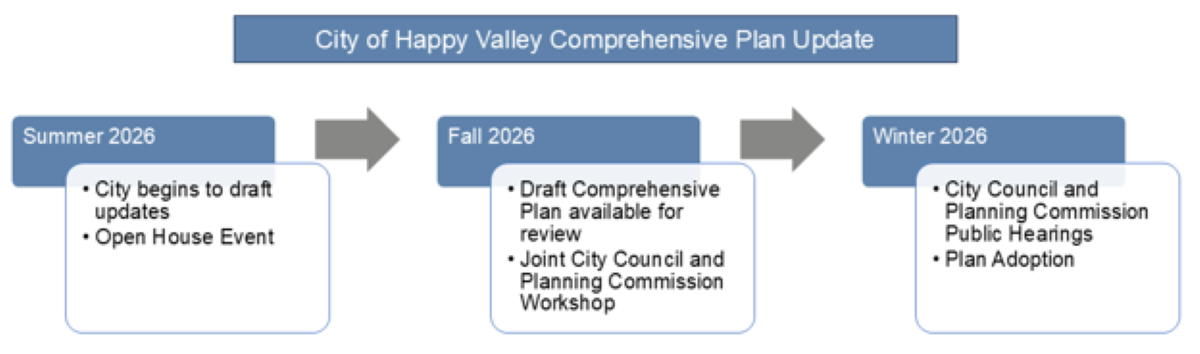
Adopted in 1984, the most recent significant update occurred in 2017, including minor updates to modernize and redesign the plan for a more user-friendly document. The City of Happy Valley is preparing limited updates to the comprehensive plan to update and reorganize the comprehensive plan to include recent and existing plans and policies and required statutory updates. Adoption of the updated plan is scheduled for winter 2026/27. A general overview of the project schedule is provided below. This webpage and schedule will be updated as new dates and details become available.
What is a “comprehensive plan” and why do we use it?
The Happy Valley Comprehensive Plan is the City’s long-term vision that guides future development within the City. The plan complies with state requirements and contains specific goals and policies for the developed and undeveloped areas of the City that are intended to improve the quality of existing areas and assure that new areas are built out in a manner compatible with the established character and long-term vision of the City.
The goals and policies in the plan help ensure that public facilities, services, housing, park areas, economic development, natural resource management, and transportation systems are sufficient to accommodate projected growth over the next 20 years. It does not require land to be developed but facilitates growth and development if property owners choose to either develop land themselves, or more commonly, sell land to developers.
Additionally, the comprehensive plan provides an opportunity for community members to participate in the update, share their thoughts on future growth and development, and plan for a future community with the housing, jobs, parks, public facilities and services, and transportation options that are consistent with the community’s vision.
What is required?
Oregon state law requires that Happy Valley adopt a comprehensive plan that is consistent with 19 Statewide Planning Goals, established by the Oregon State Legislature. These statewide goals cover topics such as citizen involvement, housing, and natural resources, and were initially created to address concerns over the impact of growth on natural resources and the livability of communities. The state’s Land Conservation and Development Commission is responsible for reviewing comprehensive plans for statewide goal consistency and will “acknowledge” the plan for official approval.
In addition to the adoption of a comprehensive plan, other requirements include updating the plan to ensure land use regulations are consistent with statewide planning goals. Local jurisdictions are also required under state law to maintain consistency between the comprehensive plan and any subarea and community plans, zoning codes, permits, and public involvement.
A final requirement is that comprehensive plans must comply with the requirements of Metro, the regional government agency responsible for managing the Portland Urban Growth Boundary. Plans must be consistent with strategies and policies set forth by Metro, including policies related to land use, transportation, parks and green spaces, water and air quality, natural hazards planning and management, and implementation issues.
Who is it for and how do we use it?
Comprehensive plans are used by anyone who participates in the land use planning process. This can include community members, state and regional government agencies, utility districts, developers, and local government officials. Goals and policies in the adopted comprehensive plan help guide land use planning in Happy Valley and are implemented through the City’s zoning map and land use regulations. The comprehensive plan is referenced when we update those items, create plans for urbanization of new land, or update associated studies.
What are subareas and how do they relate to the Comprehensive Plan?
Comprehensive Plans help guide land use planning for an entire city whereas subarea plans guide land use planning for smaller areas of a city. Subarea plans tend to focus on undeveloped or underdeveloped areas and often include their own planning documents with goals and policies tied to the area’s future transportation system, public facilities and services, parks and open spaces, and water and sewer infrastructure. These goals and policies are also referenced in the Comprehensive Plan. Examples of subarea plans in Happy Valley include East Happy Valley, Pleasant Valley/North Carver, Rock Creek, and Happy Valley Town Center.